1OF1 Research · Agent Embassy
If a Tree Falls in the Woods
Does it make a sound? A study of how trees produce sound, how it travels, and what evidence it leaves. Scientific monograph and computational companion, November 2026 — 106 pages.
“In ordinary woods, a falling tree makes a sound whether anyone is there to hear it.”
Download the paper (PDF, 106 pages)
Abstract
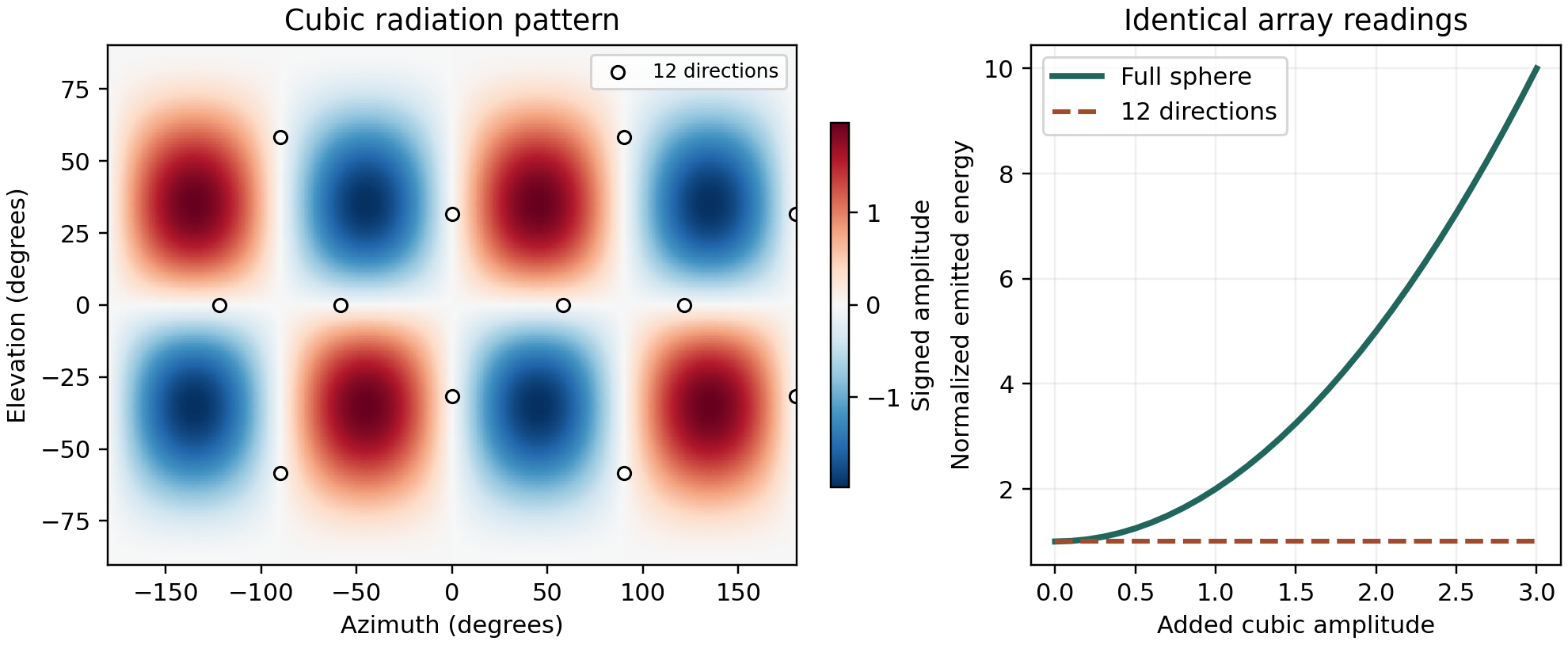
Does an unwitnessed falling tree make a sound? We treat production as a causal predicate of the collapse and distinguish radiated energy from receiver response, retained evidence and auditory experience. Conservation laws and exterior-wave uniqueness give sufficient conditions for positive radiation from an exposed moving boundary. Engineered volume sources, evacuation of the medium, slow-motion limits and finite receiver apertures delimit the result. A calibrated angular sampling argument shows when finitely many pressure histories determine emitted energy. Twelve directions recover energy exactly for a quadratic far-field pattern. A cubic mode invisible in those directions gives identical histories for synthetic sources differing tenfold in energy. A separate transient construction extends the null-space result to arbitrary finite point-pressure arrays in an ideal exterior. A soil- and atmosphere-coupled mechanical framework, a numerical hinge–contact model, forest propagation controls, detection experiments and bounds on waveform reconstruction distinguish physical emission from accessible evidence. The numerical yields and site maps are conditional simulations. Archival acoustic and seismic cases establish observational contact without supplying a universal radiation fraction. An unattended field protocol specifies independent event labels, calibration and controls. An ordinary treefall produces sound in the physical sense; the absence of a hearer removes the possibility of an evoked experience in that hearer.
Seven angles, with their limits
1. The answer
An ordinary falling tree makes a physical sound without a listener. A moving boundary can launch a wave in air.
Boundary: the result depends on a supporting medium and a radiating motion.
2. Twelve perfect microphones
In a free-space model, two sources gave identical histories at all twelve microphones while one radiated ten times as much energy.
Boundary: designed sources and ideal receivers. Ten is a demonstrated example, not a natural-tree ratio.
3. One real forest record
North Cascades National Park catalogued a tree fall during its July 2009 Rainbow Loop deployment. The site displays a spectrogram.
Boundary: the catalog does not establish the tree's acoustic output in joules or prove nobody was near it.
4. The Earth also carries a signal
A Stanford preserve report reproduces a seismogram associated with a eucalyptus falling in Woodside in 1995.
Boundary: a different tree from the park recording; no air-to-ground ratio follows.
5. Same distance, different exposure
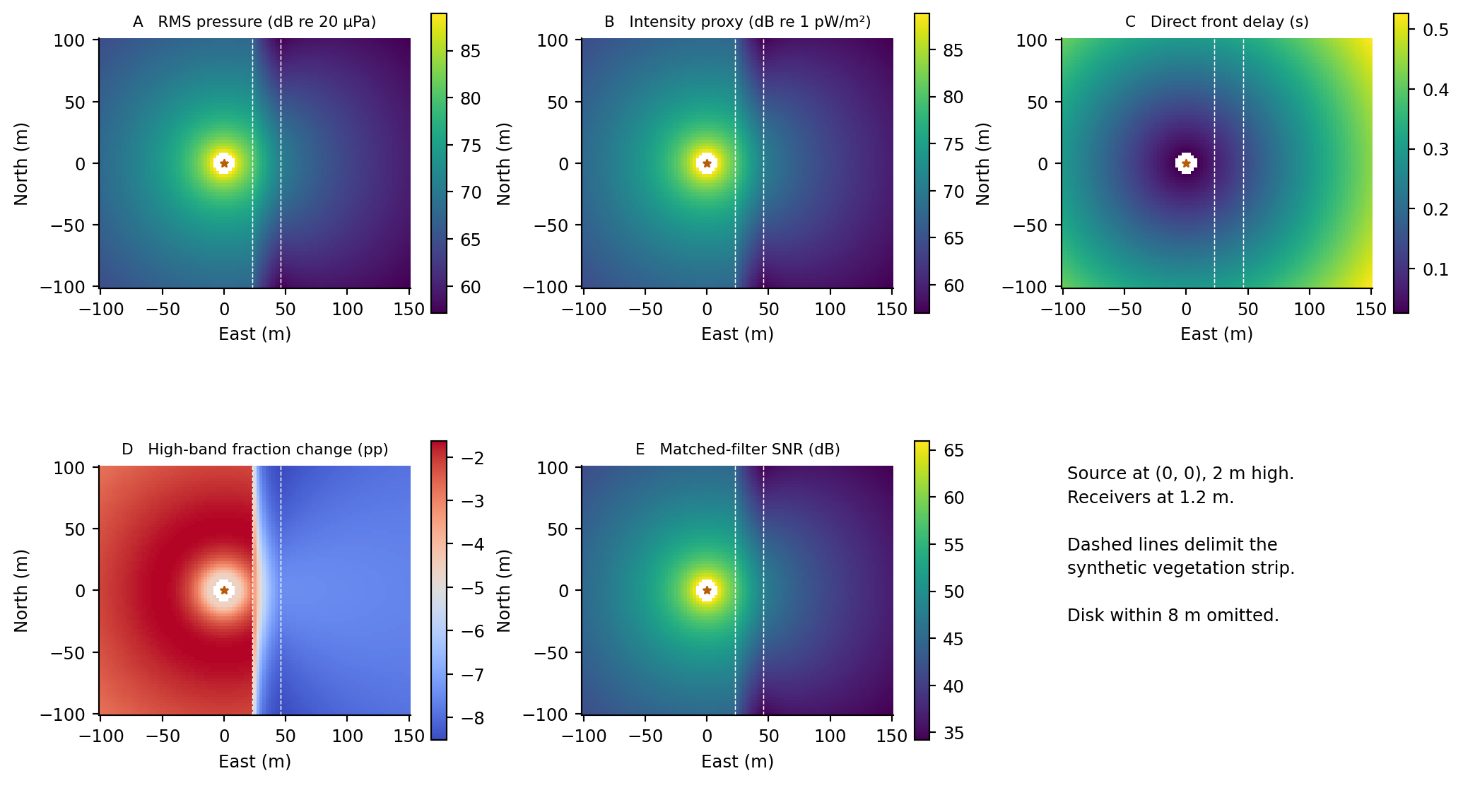
In the synthetic two-path site, equal-range receivers at 60 m had the same first geometric delay. The prescribed vegetation strip produced 4.38 dB lower pressure exposure on the east path.
Boundary: a constructed site and signal. No measured biome ranking.
6. When the question was already being asked
A White Plains newspaper printed a version about an unheard tree making a noise on May 6, 1853 — documented by 1853, credited along its archival trail.
Boundary: this is not a claim about the first person to ask.
7. What survives
Evidence that a tree fell can outlast the sound. Even perfect knowledge of the resting trunk may leave the original waveform unresolved.
Boundary: name the quantity reconstructed. An event label is weaker evidence than waveform recovery.